Wednesday, August 23, 2023

CoL Teacher Inquiry: Where am I up to?

Restate your inquiry question and your theory of action/chain of events.

My Inquiry Focus:

Will a focus on cultural visibility and prior knowledge accelerate student confidence and capability in Reading?

  • To explicitly teach inferencing to help students draw conclusions and make educated guesses based on the information provided in the text and their own background knowledge.
  • To give explicit instruction in comprehension strategies to help students understand, predict, summarise, question, visualise and make cultural connections to become strategic readers.
  • To provide explicit teaching around extended discussion to develop students’ ability to engage in in-depth conversations about a text, sharing ideas and building upon the opinions of others.  

Describe how you will collect information about the implementation of your changed practices/intervention.

  • Providing a clear explanation of what inferencing is by allowing learners to go beyond the literal meaning of the text and find the hidden meaning.

  • Incorporating Multimodal learning such as visuals, audio, and hands-on activities.

  • Tapping into learners’ cultural capital and selecting texts related to their culture.

  • Encouraging students to activate their prior knowledge by using the KWL Chart (Know-Want to Know-Learn) 

  • Teacher modelling so students know what an extended discussion looks like.

  • Providing more extension activities such as analyzing short stories, poems, or more complex texts where inferencing plays a significant role.


Timepoint 2 data (shared and analysed in this blog post) was captured through:

  • Informal teacher observation

  • Student voice through Google forms

  • Assessment (PAT & e-asTTle)

  • Recording my lesson

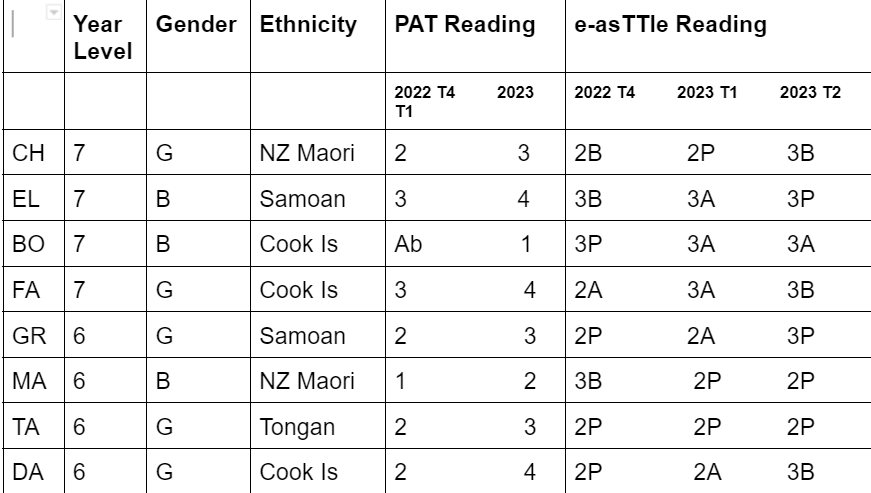
The PAT and e-asTTle assessments were carried out in mid-term 2. I am really looking forward to seeing an accelerated shift later in Term 3 and Term 4. I believe Term 1 & 2 data collection will help me to make clear comparisons at the end of the year.


Term 3 Check-in with Students

I sent a Google form to my target students to reflect on the extended discussion that is happening in the class. Here are the responses, when they were asked how having the extended discussion chains helped their reading.



I am getting there! Collaborative dialogue taps into social learning theories. Learners can benefit from each other's experiences and insights. Peer support and feedback can be motivating and helpful in overcoming comprehension challenges.


Wednesday, July 26, 2023

Time point 2 Data


CoL Teacher Inquiry: Causal Chain

Our task before the next CoL meeting was to create a causal chain to address specific areas of concern, think about our intervention, and understand more deeply what we can do as a result of a shift in student achievement.  Here is my causal chain that summarises my inquiry so far that shows a plan for my intervention in Term 3. 


 I have zoomed in on this section of my causal chain as this is my current focus looking ahead to term 3.


An integral part of my inquiry is an extended discussion whereby my students do predict, summarise, question, and clarify to improve their understanding of their text and gain more confidence in sharing.
I got this idea from Vygotsky's theories (Reciprocal Teaching) which is used to improve students' ability to learn from text. In this method, teachers and students collaborate in learning and practicing four key skills: summarizing, questioning, clarifying, and predicting.

Thursday, June 29, 2023

Formulating Hypothesis


Incorporating interactive and diverse reading activities, such as guided group discussions, storytelling, and creative writing exercises, will positively impact students' reading comprehension, critical thinking skills, and overall literacy development. As a result, students in my Reading class will demonstrate improved reading proficiency, increased interest in reading, and higher levels of academic achievement compared to those in traditional lecture-based reading classes.

As such I came up with three hunches that I have learnt so far about my students and the learning environment.

  • If I encourage my students to do more active reading such as making predictions, asking questions, and making connections then this will lead to improved comprehension.
  • If I  discuss the vocabulary related to the text prior to my Guided reading session, then they will find it much easier to understand the text.
  • If I provide opportunities for an extended discussion of text meaning and interpretation it will help my students gain more confidence and improve their thinking skills.

My Inquiry so far

  • Using a range of evidence, tools, assessments, student voice, and whanau voice to understand the students learning.

  • Understanding their strengths and the next learning steps.

  • Student voice- mid-year.

Thursday, June 22, 2023

“Creativity Empowers Learning”


Hanga - Create 2023

On Friday, June 2nd we had our cluster Teacher Only Day at Pt England School. 


"During our Kahui Ako workshops, teachers from the Community of Learning (COL) took the initiative to share and exchange ideas on how to incorporate "create" activities in their classrooms. I have always had a great passion for weaving, and I had the opportunity to try it with my class last year. We even went to Te Oro during the Matariki celebration and engaged in more weaving with flax. Therefore, I decided that weaving with Harakeke would be the best 'create activity' to share with my colleagues during the Hanga Meeting. So, I had a chat with my colleague, Rebecca, who is a new entrant teacher at our school and is also part of the COL teachers. Knowing her passion for weaving with her little ones, I was sure she would be interested, and we embarked on a perfect collaboration for this 'create' meeting.

The slide presentation we shared with our group started with a 'Karakia' (blessing), followed by explaining the 'Tikanga' (customs) surrounding the activity. We then shared the learning intentions with our fellow teachers. The meeting turned out to be a resounding success, and Rebecca and I were thrilled because it was our first 'Create' meeting, and the teachers in the group were actively engaged, busily crafting whetu (stars) from Harakeke (flax)."


Saturday, May 20, 2023

Three pieces of Professional Reading to support my Hypothesis.

Provide opportunities for an extended discussion of text meaning and interpretation

Providing students with the opportunity to participate in effective discussions regarding the significance or meaning of a text in all content areas is a way to improve reading comprehension. Teachers may guide a whole classroom discussion or monitor students as they discuss in small groups. Effective discussions may include constructing comprehension and investigating outcomes both through cognition, relating what one knows, and listening to what others have to say.


Reference: 

Kamil, M. L., Borman, G. D., Dole, J., Kral, C. C., Salinger, T., & Torgesen, J. (2008). Improving adolescent literacy: Effective classroom and intervention practices (NCEE 2008-4027). Washington, DC: U.S. Department of Education, Institute of Education Sciences, National Center for Education Evaluation and Regional Assistance.


Teaching students with comprehension difficulties

Issues with reading comprehension occur when students struggle to understand the meaning behind words, phrases and other texts.

Signs that may indicate a reading comprehension difficulty include:

  • the trouble with letter and word recognition
  • difficulty understanding words and ideas
  • slow reading speed and fluency
  • limited vocabulary or underdeveloped oral language skills
  • difficulty answering questions about or discussing a text.

When supporting students with comprehension difficulties, it is vital to understand the reason(s) behind their difficulties.

The approaches include:

  • building students' vocabulary
  • building students' background knowledge
  • modelled reading
  • shared reading
  • guided reading
  • reciprocal teaching
  • close reading.

Key elements of guided reading

Guided reading sessions are made up of three parts:

  • before reading discussion
  • independent reading
  • after reading discussion
The main goal of guided reading is to help students use reading strategies whilst reading for meaning independently.

Why use guided reading

Guided reading is informed by Vygotsky’s (1978) Zone of Proximal Development and Bruner’s (1986) notion of scaffolding, informed by Vygotsky’s research. The practice of guided reading is based on the belief that the optimal learning for a reader occurs when they are assisted by an educator, or expert ‘other’, to read and understand a text with clear but limited guidance. Guided reading allows students to practise and consolidate effective reading strategies.

Retrieved from 

https://www.education.vic.gov.au/school/teachers/learningneeds/Pages/comprehension-difficulties.aspx


Reciprocal Teaching is a contemporary application of Vygotsky's theories; it is used to improve students' ability to learn from text. In this method, teachers and students collaborate in learning and practising four key skills: summarizing, questioning, clarifying, and predicting.


Retrieved from

https://strategiesforspecialinterventions.weebly.com/reciprocal-teaching.html

How am I going to use my baseline data?

 Timepoint one data (shared and analysed in this blog post) was captured through:

  • Informal teacher observation

  • Student voice through Google forms

  • Assessment (PAT & e-asTTle)

  • Recording my lesson

The PAT and e-asTTle assessments were carried out in Week  5. I am really looking forward to seeing an accelerated shift later in Term 3 and Term 4. I believe Term 1 data collection will help me to make clear comparisons at the end of the year.


My findings about the Nature and Extent of the Student Challenge!

The challenge for my students this year is to make an accelerated shift in Reading by being more culturally visible and making use of prior knowledge that will boost confidence and capability in Reading. 


One of the significant challenges my priority group is facing is the inability to connect ideas in a text, lack of concentration during reading, needing more prior knowledge and most importantly understanding the meaning between the lines.


How to overcome these challenges?


I am trying to incorporate different ideas and thinking strategies such as Reciprocal Teaching ( Tuakana Teina), more scaffolding and providing opportunities for an extended discussion of the text. 

Some of the strategies that I have already started working on it are : 

  • More structured lessons - I have made some changes in my Reading Plan such as using multimodal planning. 


  • Activating prior knowledge

  • Explicit teaching like using small steps to allow students to understand and practise.

  • Choosing texts and activities that are appropriate and matched to their level of ability.

  • Collaborative learning - I am trying to incorporate more peer learning.

  • I am working on my feedback as well, trying to be more explicit.

I actually created a Workbook to keep a record of the texts and the reflections.