Showing posts with label Culturally Visible. Show all posts

Wednesday, August 23, 2023

CoL Teacher Inquiry: Where am I up to?

Restate your inquiry question and your theory of action/chain of events.

My Inquiry Focus:

Will a focus on cultural visibility and prior knowledge accelerate student confidence and capability in Reading?

  • To explicitly teach inferencing to help students draw conclusions and make educated guesses based on the information provided in the text and their own background knowledge.
  • To give explicit instruction in comprehension strategies to help students understand, predict, summarise, question, visualise and make cultural connections to become strategic readers.
  • To provide explicit teaching around extended discussion to develop students’ ability to engage in in-depth conversations about a text, sharing ideas and building upon the opinions of others.  

Describe how you will collect information about the implementation of your changed practices/intervention.

  • Providing a clear explanation of what inferencing is by allowing learners to go beyond the literal meaning of the text and find the hidden meaning.

  • Incorporating Multimodal learning such as visuals, audio, and hands-on activities.

  • Tapping into learners’ cultural capital and selecting texts related to their culture.

  • Encouraging students to activate their prior knowledge by using the KWL Chart (Know-Want to Know-Learn) 

  • Teacher modelling so students know what an extended discussion looks like.

  • Providing more extension activities such as analyzing short stories, poems, or more complex texts where inferencing plays a significant role.


Timepoint 2 data (shared and analysed in this blog post) was captured through:

  • Informal teacher observation

  • Student voice through Google forms

  • Assessment (PAT & e-asTTle)

  • Recording my lesson

The PAT and e-asTTle assessments were carried out in mid-term 2. I am really looking forward to seeing an accelerated shift later in Term 3 and Term 4. I believe Term 1 & 2 data collection will help me to make clear comparisons at the end of the year.


Term 3 Check-in with Students

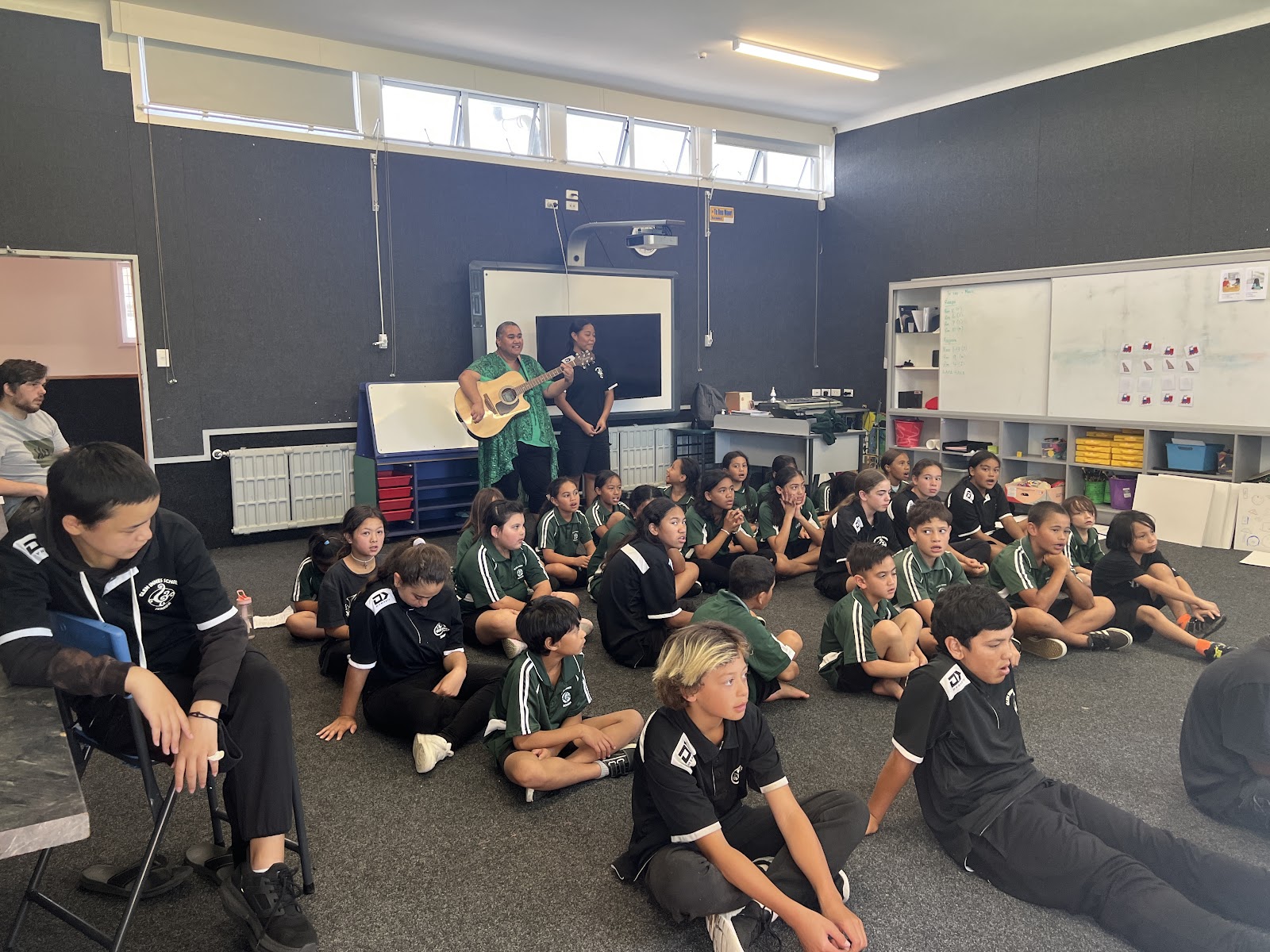
I sent a Google form to my target students to reflect on the extended discussion that is happening in the class. Here are the responses, when they were asked how having the extended discussion chains helped their reading.


I am getting there! Collaborative dialogue taps into social learning theories. Learners can benefit from each other's experiences and insights. Peer support and feedback can be motivating and helpful in overcoming comprehension challenges.


Wednesday, May 3, 2023

Eliza's beautiful thought about the Indian Classical Dance!

We had our cultural celebration in Term One and this is what some students came up with. It was really nice to see the cultural integration taking place. Eliza is a NZ Maori but she chose to write about Indian Culture. On the other hand, Chloe who is a NZ Maori as well, she chose to do an Indian Classical dance. This cultural celebration tends to be a rich learning experience for the Glen Innes students as they were able to do a lot of research work after the celebration and came up with brilliant slide presentations and other interesting activities.


Response to Cultural Celebration Slides


As Vygotsky mentioned, children's cognitive development is affected by culture in two ways. First, children acquire most of their knowledge (the contents of thought) through culture. In addition, not only does culture teach children what to think but also how to think.

Thursday, March 9, 2023

This is how I have stepped into 2023 by being more culturally visible!

During this 9 years of my teaching journey in New Zealand I felt that my classroom to some extent wasn’t culturally inclusive for all my students. Many of my Māori and Pasifika students were disadvantaged. Either it was due to not enough time, busy schedules, lots of other extra curricular activities happening and the pandemic that took so much of our precious learning time.  

After completing my TESSOL studies with The University of Auckland I feel good Pasifika learning requires that the teacher must have all three of the following teaching strategies: allowing Pasifika students respect as a learner; being able to scaffold Pasifika learning at the right level and engaging their Pasifika students in active learning. The Pasifika student must have confidence and trust in their teacher to engage with the teacher in the active pursuit of learning. The classroom teacher must also have confidence in the Pasifika student’s ability e.g., high expectations. If any of the parts described above are missing that means we as teachers must make some changes in our practice.

At GI school Term 1 is always very rewarding and we teachers are blessed to see our students showcasing their talents and culture. They celebrate their culture in a huge way and the whanau is so proud to see their children performing. However, this only lasts till term 1 and afterwards I could see our multicultural school is not doing much for what our children already have. One of the most valuable assets that they have is their cultural values. They know so much yet we as teachers do not actually see the full potential and other great benefits. We are not using their cultural capital which in fact carries so much weight.  We are trying to use other modern online teaching resources like Twinkl, Resource cupboard, Reading Eggs and so on  to improve their Reading and Writing. I am not saying these resources are of little value . I do agree that it helps, our tamariki enjoy and we as teachers are able to get so many good things for our tamariki. In saying that if  our learners  interact socially and share their cultural stories, that would actually help them to gain more confidence.  Instead of knocking on their prior knowledge, we begin to introduce more new and foreign things that go over their head. Why can’t we understand that this problem can be handled in a much easier and traditional way!

So this is how I have stepped into 2023 by being more visible in culturally responsive teaching. That means using students' customs, characteristics, experience, and perspectives as tools for better classroom instruction.